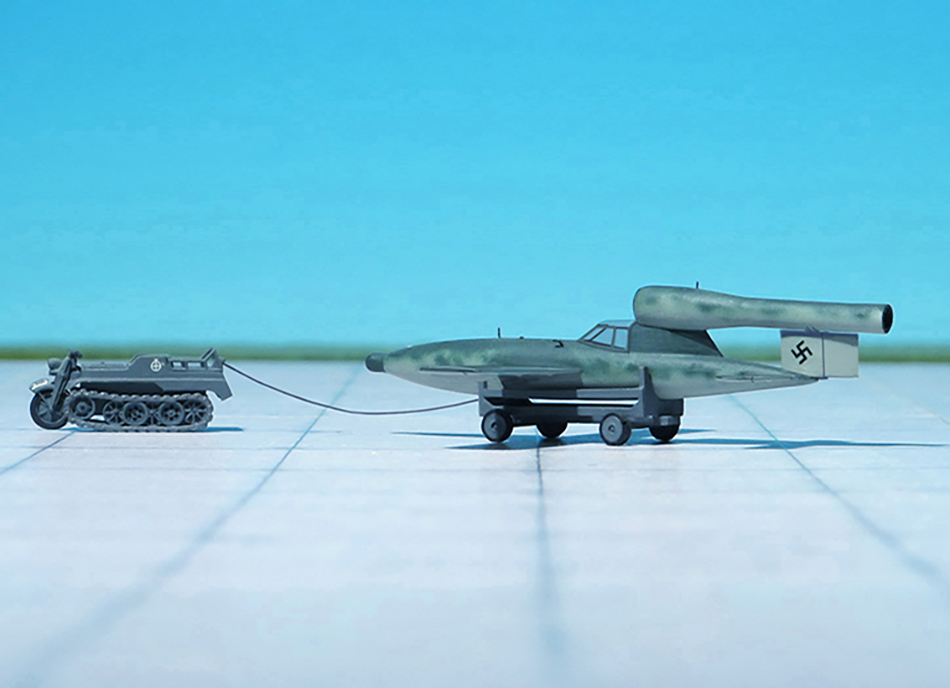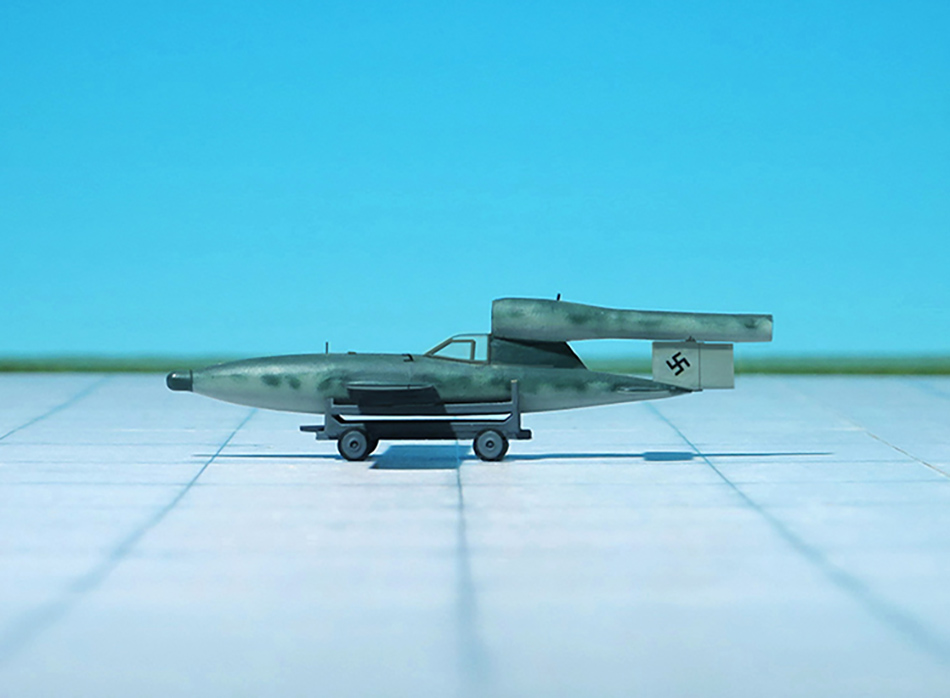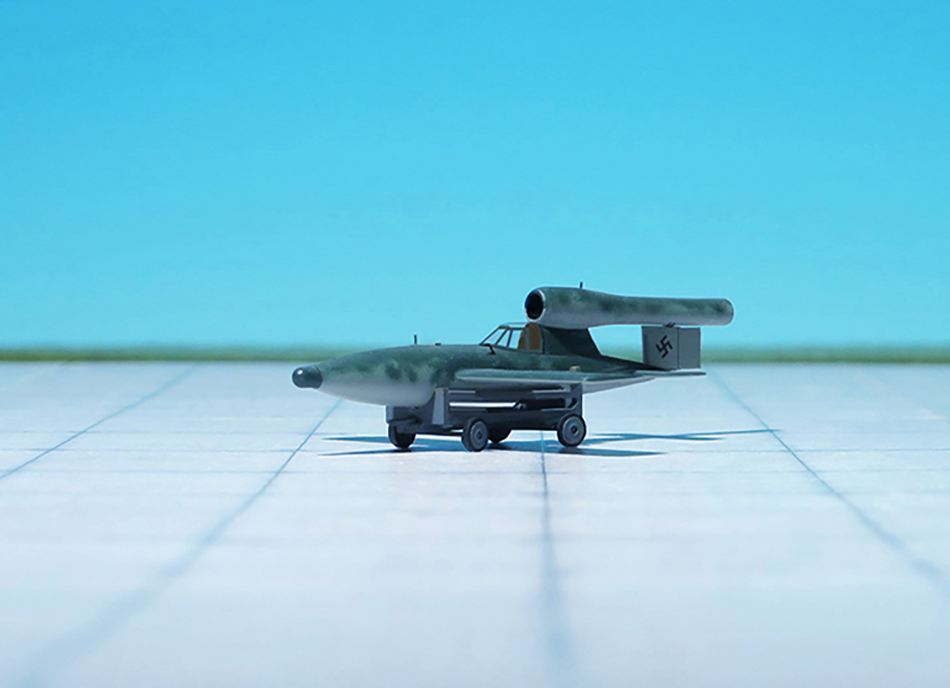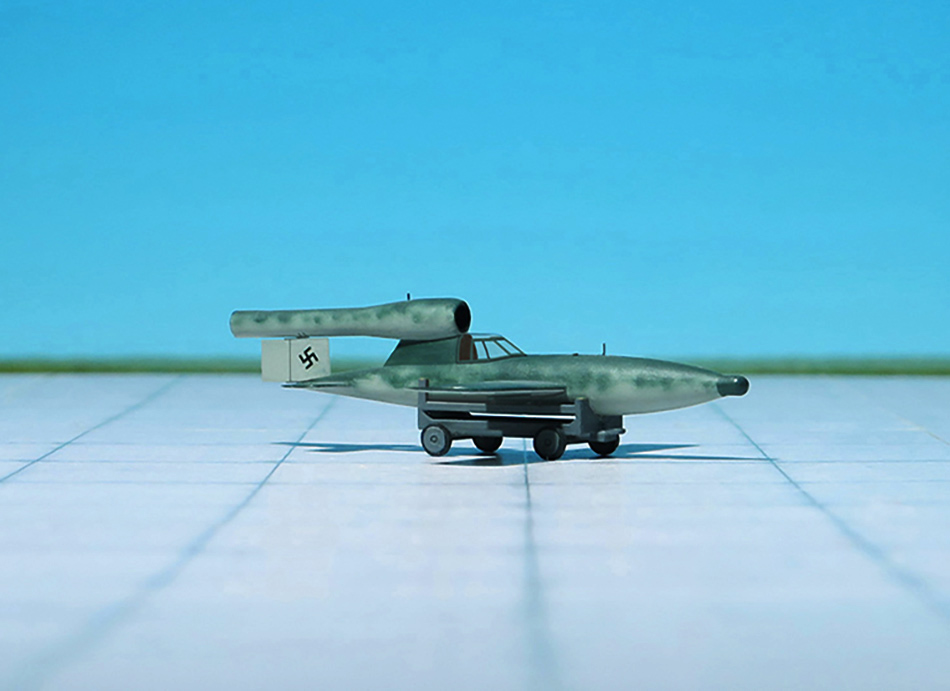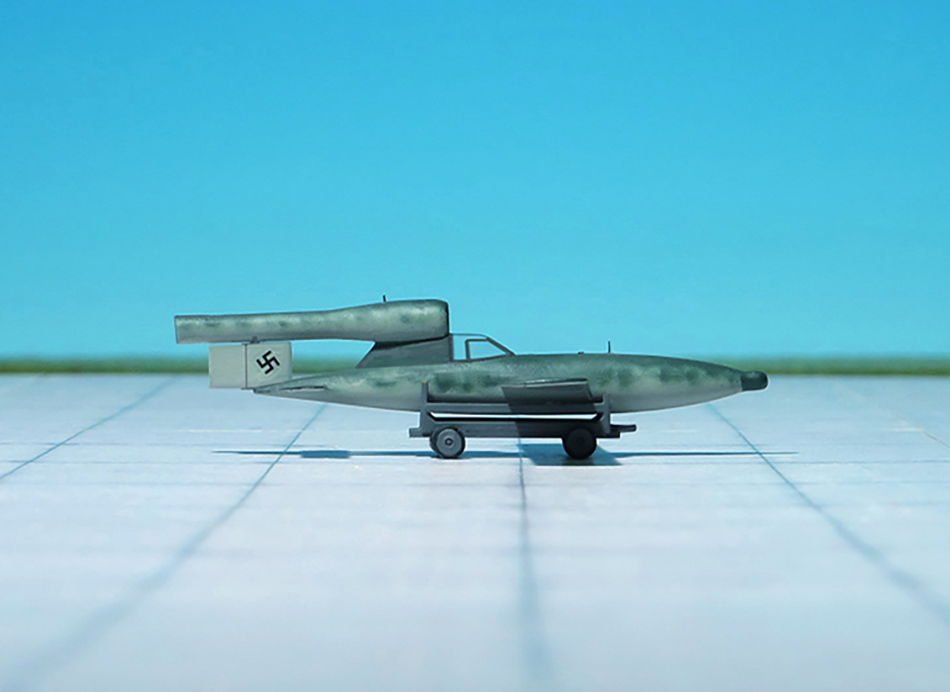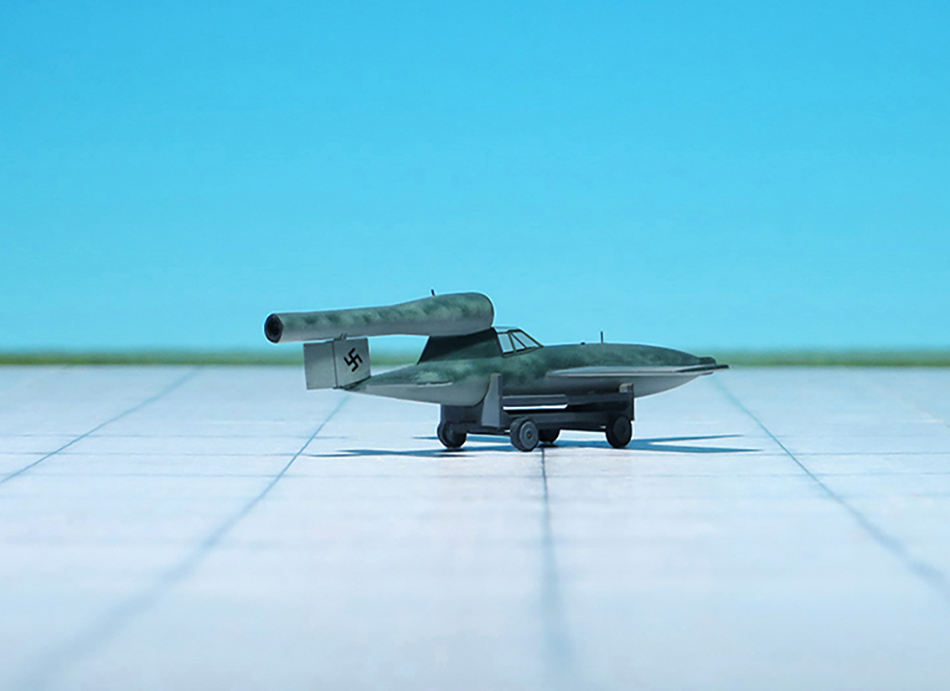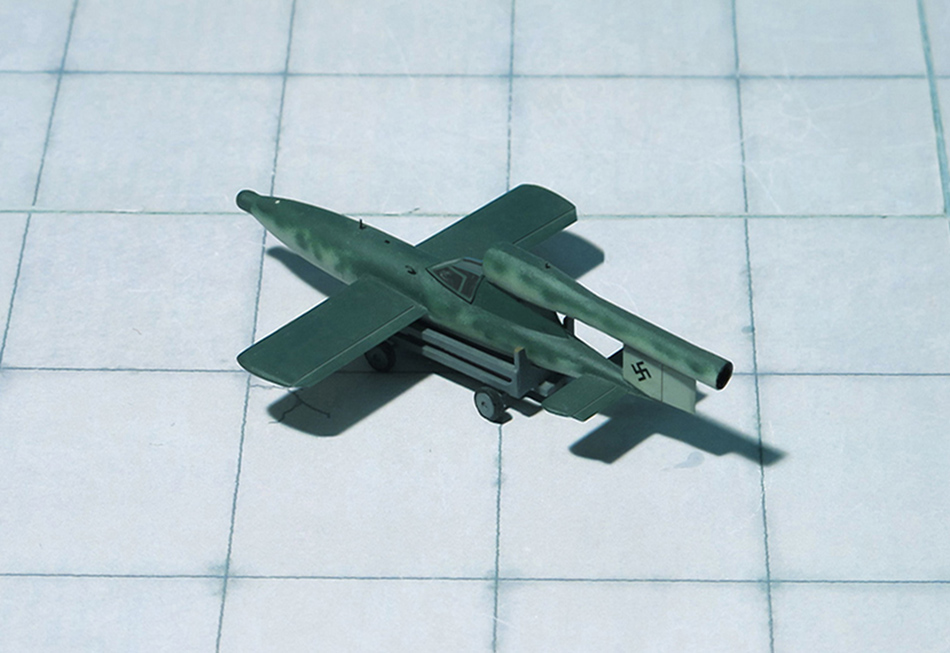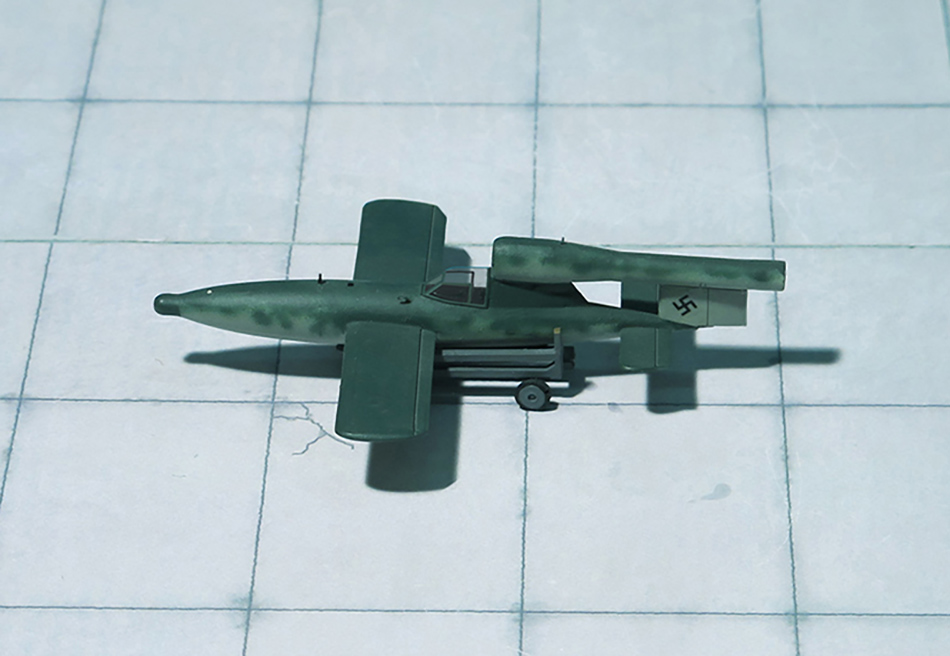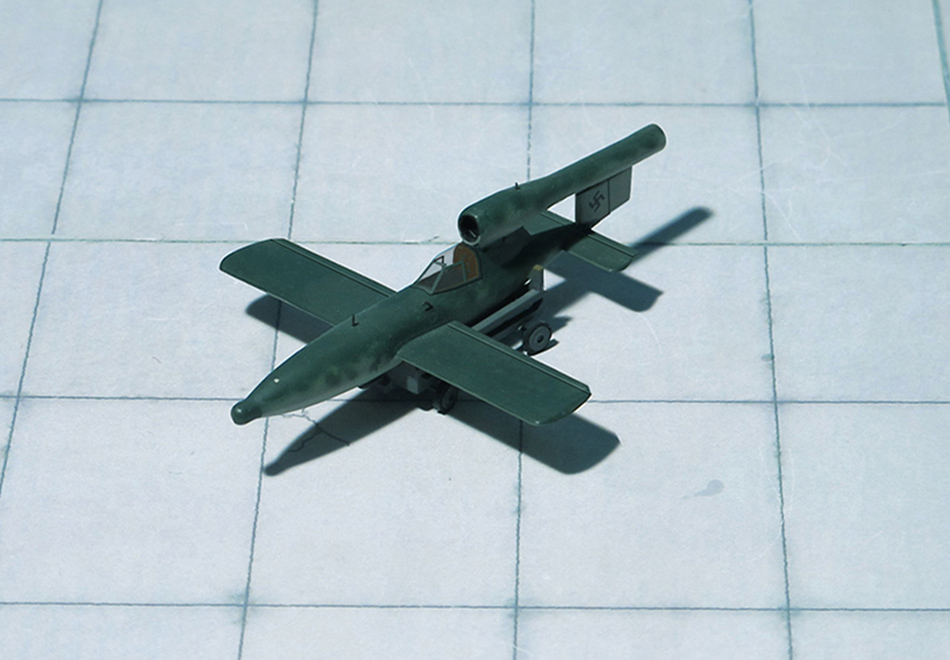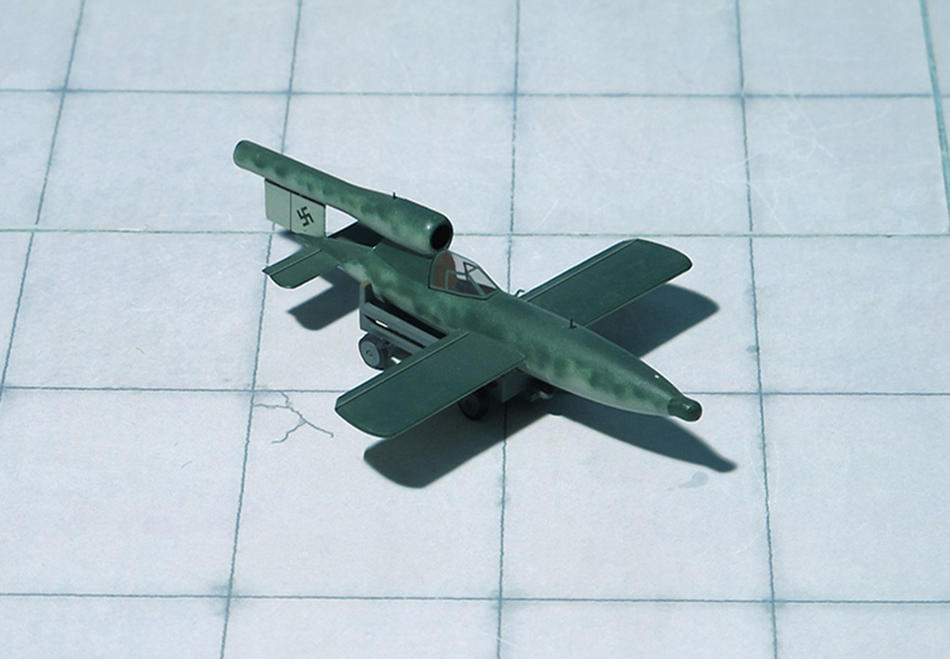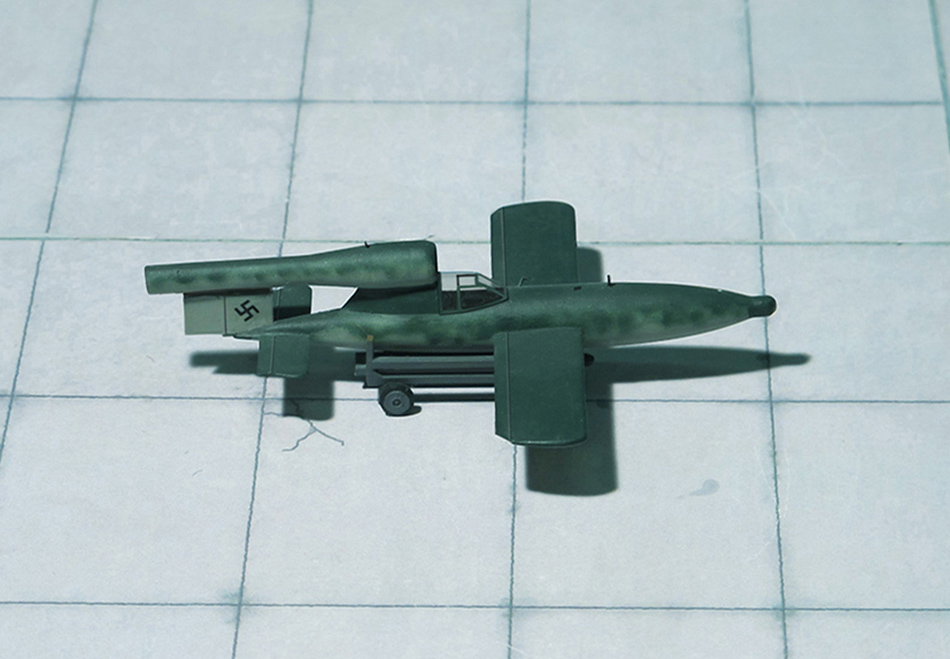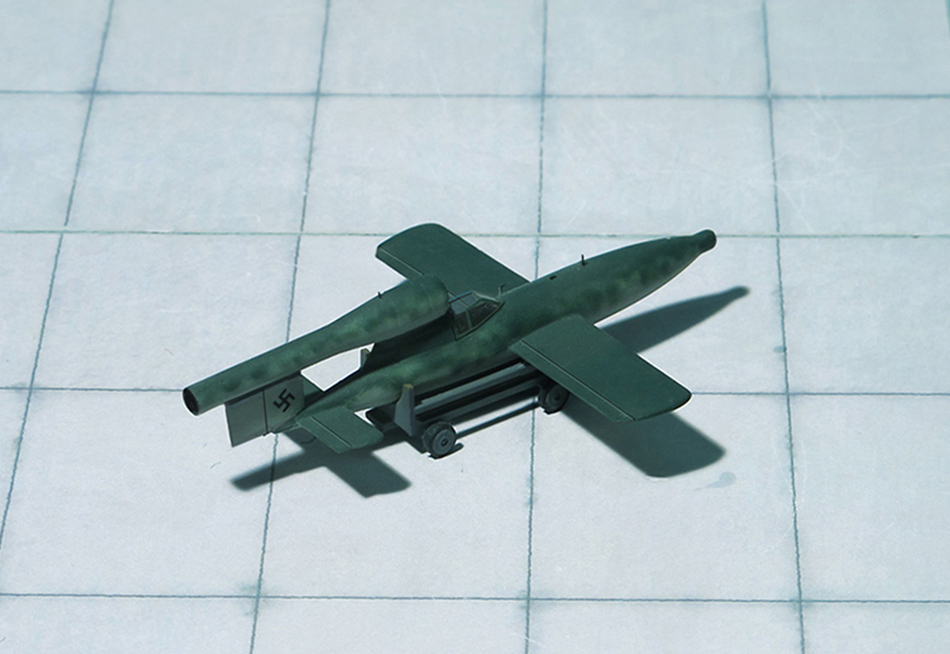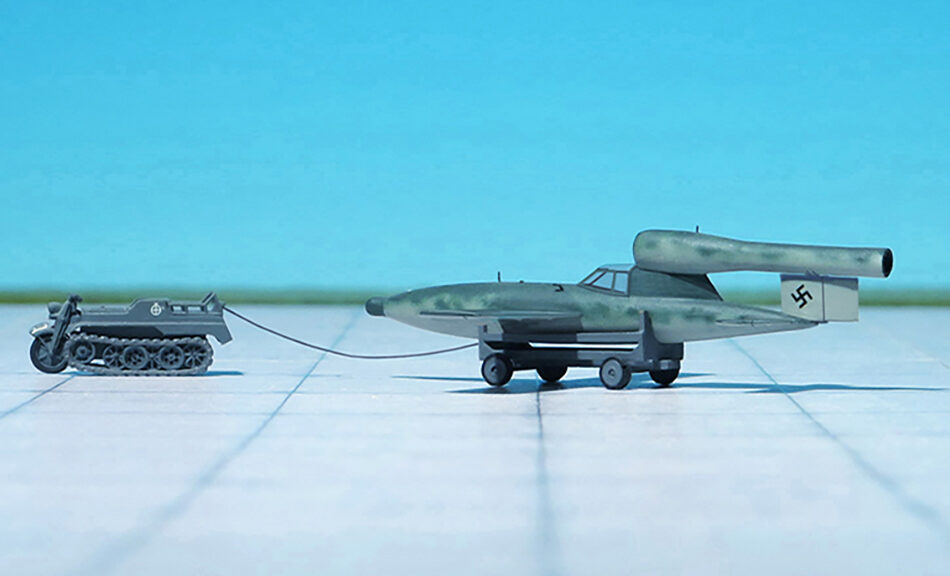
TYPE: Manned V-1 Flying bomb
ACCOMMODATION: Pilot only
POWER PLANT: One Argus As 109-014 pulsejet, max 367 kp thrust
PERFORMANCE: 400 mph at 8,000 ft
COMMENT: The Fieseler Fi 103 Re, code-named Reichenberg, was a German manned version of the V-1 Flying bomb (more correctly known as the Fieseler Fi 103). It was developed towards the end of the WW II and was intended to be used as a human-guided bomb in suicidal attacks against the advancing Allies.
The Fi 103 Re started development in 1944 at a time when Germany was anticipating a major naval landing by the Allies in Western Europe. It was believed that a disposable aircraft armed with 2,000 lb of explosives would potentially inflict heavy damage on important targets such as enemy shipping. However, these attacks would have very likely involved the death of the pilot, who was expected to exit the aircraft and parachute away mere moments before the aircraft’s impact. These pilots were reportedly to be volunteers and aware of the risk to their own lives.
Initially, the development of a manned Fi 103 Re 4a had been considered but passed over for the rival Messerschmitt Me 328 project. However, this aircraft had fundamental difficulties with its pulsejets propulsion, which led to officials opting to switch focus to the Fi 103 Re’s development.
The concept called for an aircraft that would be armed with a single 2,000 lb explosive device that would detonate upon impact with the target, which was typically envisioned to be Allied shipping. Two different aircraft were quickly considered to be the most suitable options available, the Messerschmitt Me 328 and the Fieseler Fi 103, better known as the V-1 flying bomb, although both required development work. Officials opted to pass over the Fi 103 Re in favour of the Me 328. Being largely composed of wood and conceived of as potentially suitable for using multiple means of propulsion, the Me 328 had been worked on since 1941.
However, difficulties were encountered in the Me 328 during prototype testing, the vibration caused by its pulsejet engines having been a particular source of issues, leading to work being suspended.
In the summer of 1944, the Deutsche Forschungsanstalt für Segelflug (DFS, German Research Institute for Sailplane Flight) took on the task of developing a crewed version of the Fi 103, an example was made ready for testing within days and a production line was established at Dannenberg.
The V-1 was transformed into the Reichenberg via the addition of a compact cockpit at the point of the fuselage that was immediately ahead of the pulsejet’s intake, where the compressed-air cylinders were fitted on a standard V-1. This cramped cockpit was outfitted with only basic flight instrumentation, along with a bucket seat composed of plywood. The single-piece canopy incorporated an armoured front panel and opened to the side to allow entry. The two displaced compressed-air cylinders were replaced by a single one, fitted in the rear in the space which normally accommodated the V-1’s autopilot. At no point was any landing gear fitted to the aircraft. The wings were fitted with hardened edges that would cut the cables of barrage balloons.
Trainees were initially prepared using ordinary gliders to get them used to handling unpowered flight; specially-adapted gliders with shortened wings would be used to provide more advanced training. Amongst other things, these adaptations enabled them to dive at speeds of up to 190 mph. Once sufficient proficiency had been demonstrated, the last stage of training would be conducted using the dual-control unpowered Fieseler Fi 103 Re 2. There was no shortage of volunteers for the programme despite the open acknowledgement that the mission involved their near-certain demise.
Training began on the both unpowered Fi 103 Re 1 (single seat) and Fi 103 Re 2 (dual seat) gliders, although landing them on a skid was difficult. The aircraft handled well and it was anticipated to be using the machines. Also, a pulsejet powered training aircraft the Fieseler Fi 103A-1/Re 3 were used showing good performances.
On July 1944, Albert Speer, Minister of Armaments and War Production, wrote to Hitler, stating his opposition to the wasting of both men and machines on the Allies in France and suggested their deployment to be more worthwhile against Soviet power stations on the Eastern Front. These were not the only alternative targets that were proposed; other potential uses for the Fi 103 Re 4 included ramming enemy bombers. Such was the interest in this latter role that formal evaluations were conducted in the final months of the conflict.
It was proposed that a Heinkel He111 bomber would carry either one or two Reichenbergs beneath its wings, releasing them close to the target. The pilots would then steer their aircraft towards the target, jettisoning the cockpit canopy shortly before impact and bailing out. It was estimated that the chances of a pilot surviving such a bailout were less than 1% due to the proximity of the pulsejet’s intake to the cockpit.
During September 1944, the first real flight was performed at the Erprobungsstelle Rechlin, the Reichenberg being dropped from a Heinkel He 111. However, this flight ended in a crash, which was attributed to the pilot having lost control of the aircraft after accidentally jettisoning the canopy. The next day, a second flight was conducted that also ended in a crash. The technical department struggled to explain these losses, although there were suspicions that the Fi 103 Re’s flight characteristics could make landing particularly challenging.
On October 1944, development was shelved at the direct order of Hitler, who had been encouraged by Alberts Speer not to pursue suicide attacks (Ref.: 24).